

Preparing people and organisations for the environment ahead
Over the past six months we have been working closely with certain British Army units, observing performance in demanding training environments and speaking directly with those moving through critical transitions such as the Platoon Commanders Battle Course at Brecon for young officers.
This work has reinforced something that is consistently visible across high-performance environments.
“People rarely fail because they lack capability.
They fail because the environment has moved ahead of their preparation.”
The Performance Delta
Across military, sport and business, the same pattern appears.
There is always a gap between:
1. The capability an individual, team or organisation currently possesses and:
2. The capability required in the environment they are about to enter
This gap is what we refer to as the Performance Delta.
It is not a new phenomenon.
It emerges whenever people move into environments that are:
• faster
• more complex
• more uncertain
• more consequential
A Performance Delta appears when the environment changes faster than the individual or organization can adapt.
Where Performance Really Breaks
Most organisations invest heavily in developing extrinsic capability:
• technical skill
• leadership training
• processes and systems
Far fewer prepare for the systemic environment ahead.
The issue is not the difficulty of the environment itself.
It is the transition into it.
This is where performance most often breaks.
Intrinsic, Extrinsic and Systemic
In practical terms, performance sits across three interacting elements:
Intrinsic → Extrinsic → Systemic
• Intrinsic capacity - Energy, resilience, judgement under pressure
• Extrinsic capability - Skills, leadership, execution
• Systemic environment - The conditions in which performance takes place
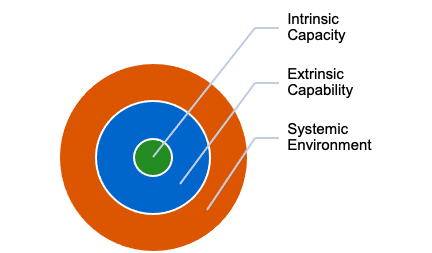
Fig.1 – The Balance between the Intrinsic, Extrinsic and the Systemic
When the systemic environment increases or changes beyond intrinsic capacity and extrinsic capability, the Performance Delta becomes visible.
The Military as a Case Study
The Army provides a clear illustration.
Training environments such as the Royal Military Academy Sandhurst develop strong foundations.
But a follow-on course like the Platoon Commanders Battle Course introduces:
• Greater sustained fatigue
• Compressed decision-making
• Increased responsibility
• Real leadership pressure
The environment changes.
Even capable individuals can struggle — not because they lack skill, but because they have not yet been fully prepared for that specific environment.
A Broader Pattern
What is observed in military environments is increasingly visible elsewhere.
We see it when:
• High-performing individuals struggle after promotion
• Leadership teams falter under pressure
• Organisations underperform in new or volatile markets
In many cases, the capability is still there.
But the environment has moved ahead of it.
In financial services, this pattern is particularly evident.
High-performing private bankers and portfolio managers often succeed in stable, relationship-driven environments where performance is built over time through trust, consistency and incremental growth.
However, when the environment shifts — through market volatility, increased client scrutiny or performance pressure — the demands of the role change.
• The pace of decision-making increases.
• Uncertainty becomes more pronounced.
• The consequences of decisions become more immediate and visible.
In these conditions, the capability that drove past success is not always sufficient.
The challenge is not technical knowledge.
It is the ability to operate effectively in a different systemic environment.
This is where the Performance Delta becomes apparent.
Evidence from Fighting Power
Recent commentary in the Spectator magazine by General Sir Michael Rose, KCB, CBE, DSO, QGM, DL and ex Special Forces officer reflects this clearly.
He emphasises the importance of the moral component of fighting power, and notes:
“Complicated health and safety rules are producing a generation of risk-averse service people.”
And
“The demands of war are clearly quite different from those of civilian life…”
Viewed through this lens, this is not simply critique.
It is a reflection of a wider issue:
- when the environment changes, but preparation does not change at the same rate, performance becomes misaligned.
“Capability wins in stable environments.
Alignment wins in changing ones.”
The Intrinsic Factor
One of the most overlooked aspects of performance is intrinsic capacity.
A person may have the technical capability for the next level.
But can they still perform when:
• fatigue increases
• scrutiny rises
• uncertainty expands
• responsibility grows
The same applies to organisations.
Extrinsic capability determines what can be done.
Intrinsic capacity determines what can be done under pressure.
Crossing the Performance Delta
The challenge is not simply identifying the Performance Delta.
It is being ready to cross it when performance is tested.
In practice, this requires a structured approach:
1. Assess the systemic environment ahead
2. Understand the nature of the gap
3. Prepare specifically for that environment
You cannot prepare for an environment you have not clearly defined.
One of the most consistent examples of the Performance Delta appears in leadership transitions.
Individuals are often promoted based on success in their current role — technical competence, execution and reliability.
Yet the next role demands something different:
• leading rather than doing
• making decisions with incomplete information
• carrying accountability for others
• operating under greater scrutiny
The environment changes faster than the individual adapts.
What worked before no longer works in the same way.
This is not a failure of capability.
It is a failure to prepare for the new environment of performance.
Pre-Conditioning
In high-performance settings, this preparation is best understood as Pre-Conditioning.
Not simply training harder.
But preparing specifically for the demands of the next environment:
• decision-making under pressure
• operating with uncertainty and ambiguity
• sustaining performance under load
• leading under scrutiny
When individuals and organisations experience the demands of the next environment before they enter it, adaptation becomes far more effective.
Simplicity Under Pressure
Across all domains, one pattern is consistent.
High performers simplify.
Under pressure they focus on:
• the immediate task
• the team
• the next decision
Why This Matters
The pace of change is increasing.
- Markets shift faster.
- Roles evolve earlier.
- Pressure intensifies.
The organisations that perform best are not those with the most capability.
They are those that are best prepared for the environment they are about to enter.
Most organisations only recognise the Performance Delta once performance begins to decline.
By that point, the environment has already been entered.
At its core, this is about alignment.
• Intrinsic capacity
• Extrinsic capability
• Systemic environment
When they align, performance is consistent.
When they do not, the Performance Delta appears.
Performance is decided before the environment is entered.
If you are interested in understanding where Performance Deltas may exist within your team or organisation — or how to prepare for the environment ahead — I would be very happy to continue the conversation.